Let Istar help you get started on your project with our experience and know-how!
Upload your design files and production requirements and we will get back to you within 30 minutes!
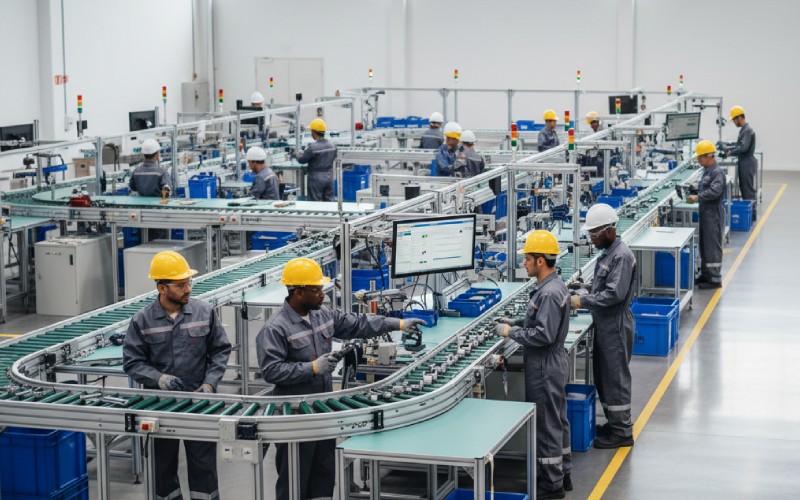
Most articles about the 7 wastes of lean throw a list at you, add a few factory examples, and call it a day.
But waste isn’t just numbers on a dashboard. It’s:
This guide will still cover the classic seven wastes from the Toyota Production System (TPS), but with a more human lens — how they feel, how they show up in real days, and how to start changing them without burning people out. The core categories are widely accepted in lean thinking: Transportation, Inventory, Motion, Waiting, Overproduction, Over-processing and Defects.
(Some practitioners add an 8th: underutilized human talent. We’ll weave that in throughout, because ignoring people is the fastest way to guarantee all the other wastes stay.)
The idea of “waste” here comes from the Japanese word muda, meaning futility or uselessness — work that consumes resources but doesn’t create value a customer would willingly pay for. In the Toyota Production System, Taiichi Ohno grouped these into seven main categories and linked them with two other enemies of flow: mura (unevenness) and muri (overburden).
That list was born on automotive shop floors, but it maps frighteningly well to office work, software, healthcare, logistics, and even solo freelancing. Wherever there’s a flow of work from “idea” to “delivered”, you can find these same patterns.
Before diving deep, here’s a human-friendly snapshot.
| Waste | Simple definition | How it feels to people | Early warning signs |
|---|---|---|---|
| Transportation | Unnecessary movement of materials/info | “Why does this have to go through so many hands?” | Extra handoffs, long physical routes, many systems/tools |
| Inventory | More stuff or work than needed right now | “There’s so much… I don’t even know where to start.” | Piles, queues, backlogs, “in case” stock |
| Motion | Unnecessary movement of people | “My job is 50% walking and searching.” | Awkward reaches, walking for tools, hunting for files |
| Waiting | Idle time when people or machines can’t proceed | “I spend my day chasing updates.” | People checking status, blocked tasks, slow approvals |
| Overproduction | Making more or earlier than needed | “We worked so hard… and no one uses it.” | Full warehouses, unused features, “just in case” batches |
| Over-processing | Doing more work than customers value | “It’s never good enough; we over-polish everything.” | Extra reports, excessive documentation, too-tight tolerances |
| Defects | Errors causing rework or scrap | “We keep fixing the same problems; it’s demoralizing.” | Firefighting, returns, rework loops, finger-pointing |
This is the map. Now let’s walk the territory — one waste at a time, with what it does to both your numbers and your people.

Overproduction is often called the mother of all wastes because it triggers many of the others: excess inventory, more motion, more transport, more defects risk. It’s producing more than customers need, or producing it sooner than they need it.
In human terms, overproduction is seductive. It feels like productivity: machines running, people busy, dashboards green. But under the surface, it quietly builds anxiety (where will we store this?), risk (what if specs change?), and invisible cost (cash tied in stuff instead of innovation).
Waiting is idle time: people, products, or information sitting still because the next step isn’t ready. A line stops; a ticket is “pending approval”; an operation can’t continue because a part or decision is missing.
People experience waiting as friction and helplessness. You see it in body language: technicians leaning on machines, project managers refreshing dashboards, nurses chasing signatures instead of treating patients. Morale drops because effort doesn’t translate into progress.
Transportation waste is about moving things — parts, paperwork, files — more than necessary. Every extra trip adds time and risk, but no value. In physical environments, that’s forklifts, trucks, pallets. In office and digital work, it’s handoffs between teams, systems, or tools.
People feel transportation waste as bureaucracy and fragmentation. “I don’t know where it is” becomes a normal sentence. Work disappears into black holes: a shared inbox, a queue, a shared drive with ten “final_v7_reallyFINAL” folders.
Inventory waste is having more items in the system than needed right now: raw materials, work-in-progress (WIP), finished goods, or even digital work (tickets, features, content) waiting to be processed.
On a spreadsheet, inventory is “assets”. In reality, excess inventory is stress made physical: crowded warehouses, cluttered workstations, endless backlogs. It hides problems — you don’t see process issues because you can always buffer with more stock — and it consumes cash that could be used for training, tools, or new products.
Motion waste is unnecessary movement of people: walking, reaching, twisting, searching, clicking through endless screens. It’s not the distance a part travels (that’s transportation), but the effort humans expend to navigate a poorly designed workspace or system.
You see motion waste in aching backs, tired feet, and “I spend half my day looking for things.” It’s a safety risk as well as an efficiency problem.
Over-processing is doing more work than the customer actually values: tighter tolerances than needed, more approvals than risk justifies, extra reports nobody reads, or over-engineered features.
At the human level, over-processing often comes from good intentions: pride in craftsmanship, fear of criticism, desire to be “thorough.” But without clear standards and feedback from real customers, this energy turns into waste — and burnout.

Defects are errors that require rework or scrap. They’re the visible symptom of deeper problems in process design, training, materials, or communication. In manufacturing, this means non-conforming parts. In services and office work, it’s wrong invoices, mis-shipped orders, incorrect data, or software bugs.
For people, chronic defects are demoralizing. Teams feel like they’re constantly “fixing yesterday” instead of building tomorrow. Customer-facing staff absorb the emotional cost when they have to apologize, again and again, for problems they didn’t cause.
Many leaders “know” the 7 wastes conceptually but struggle to see them in their own environment. A simple, powerful practice from lean is the Gemba walk — going to the place where work happens and observing reality with curiosity.
Here’s a lightweight version you can do in an hour.
Lean often gets caricatured as “do more with less.” Done badly, a 7-wastes initiative feels like management hunting for “lazy” people. Done well, it’s almost the opposite: leadership looks for ways to remove friction so people can do their best work more easily.
That’s why many modern lean practitioners talk about an “8th waste”: underutilized human talent — not involving people in problem-solving, not using what they know, not giving them the conditions to contribute fully.
If you strip away the jargon, lean is really about respect:
The 7 wastes of lean production give you a shared language to talk about what’s getting in the way of that respect. The competitive advantage comes from how you use that language: with curiosity instead of blame, experiments instead of edicts, and a deep commitment to making everyday work feel less frustrating and more meaningful.
If you start there — one value stream, one Gemba, one small experiment — you’ll already be ahead of most organizations who stopped at memorizing “TIMWOOD” and never made it human.