Let Istar help you get started on your project with our experience and know-how!
Upload your design files and production requirements and we will get back to you within 30 minutes!
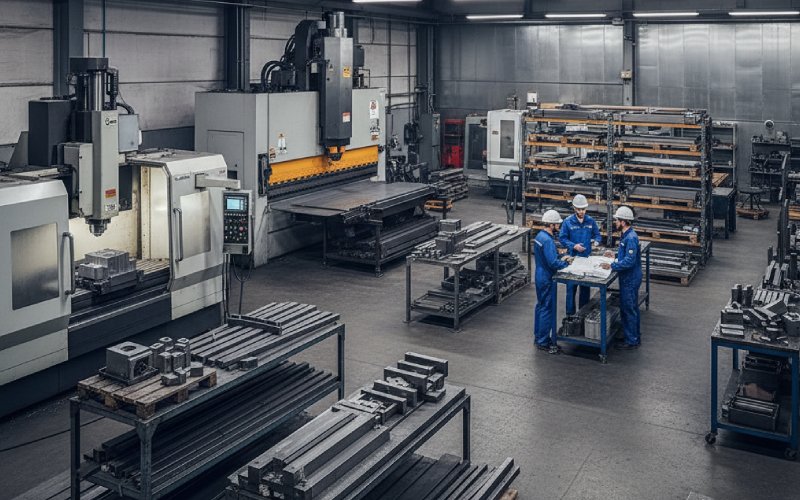
Most of the time the choice is simple: if the part is thick, 3D, and tolerance-critical in low or mid volumes, CNC is the rational answer. If it is thin, mostly planar, and you care about repeatable volume more than microns, sheet metal carries the work. The interesting part is everything that sits between those two ends, where geometry, volume, and change frequency quietly shift the break-even point by tens of percent. That is where most teams leak money and schedule.
If you start by asking which process to use, you are already one step late. The sharper question is: “What is the shape and lifetime of this part, and how painful will change be later?”
CNC machining treats your part as a solid block with material carved away. It pays you back when you need complex 3D forms, deep pockets, blended surfaces, or critical fits in a single datum system, especially at low to medium volumes.
Sheet metal assumes your part wants to be made from flat stock, bent, cut, and joined. It shines when the structure is mostly panels, flanges, and brackets, and when volume and repeatability matter more than microns on every feature.
So the process is not the goal. The process is a side effect of geometry, volume, and how many times you expect the drawing to change after first build.
Imagine you freeze the part and look only at cross sections. If most load-bearing paths are plates, ribs, and boxes, the part is quietly asking for sheet metal. If load paths run through thick bosses, contoured ribs, and local 3D features, it is leaning toward CNC or a hybrid structure.
Competitor articles repeat that CNC is best for “complex shapes” and sheet metal for “simple bent forms”. That is too blunt. A better mental filter:
If the part could be cut from flat stock, folded, and maybe locally stiffened, without faking the stiffness with excessive thickness, then sheet metal is probably the natural fit. If you need deep cavities with variable wall thickness, integrated bearing seats, or intersecting curved surfaces that cannot be unfolded, you are in CNC territory.
There is also scale. Very large structures tend to drift toward sheet metal and welding, because machine travel and fixturing for full CNC operations become awkward and expensive. At the opposite extreme, very small precision features may require CNC or at least some machining operations even if most of the part is sheet.
Real designs rarely sit at one clear end. That is why the next topic—cost structure—decides far more than the process names suggest.
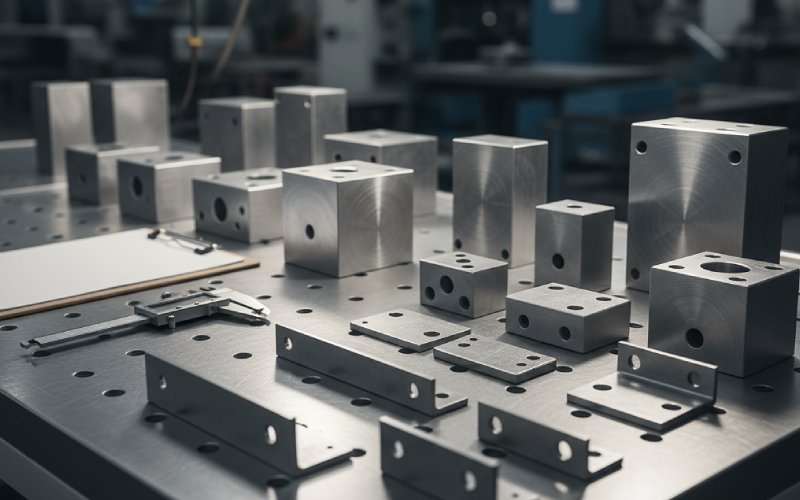
A lot of blog posts stop at “CNC is expensive; sheet is cheap.” They are half right.
CNC cost is dominated by setup time, cycle time, and how much material you decide to turn into chips. Complex geometry, extra setups, and difficult materials all push the cost up, even when volumes are modest.
Sheet metal has a different curve. For low to moderate volumes, laser cutting plus bending has manageable setup cost and quick cycle time. For very high volumes, stamping and progressive tooling drive the per-part cost down, but you now carry tooling design, build, and maintenance as an upfront investment.
Engineers often sense this qualitatively. It helps to look at it side by side.
| Design / Business Aspect | CNC machining usually makes more sense when… | Sheet metal usually makes more sense when… |
|---|---|---|
| Annual volume | You expect tens to a few thousand parts per year, and volumes may fluctuate or stay uncertain. | You expect hundreds to tens of thousands per year with relatively stable demand. |
| Geometry | You need deep pockets, blended 3D surfaces, thick sections, or complex internal features in one setup. | The form is predominantly panels, flanges, and open sections that can be cut and bent from flat stock. |
| Material thickness | Stock is thick plate, bar, or billet, or you need local thickness changes that cannot come from a single sheet gauge. | The structure can be built from standard gauges, usually below a few millimetres for common enclosures and brackets. |
| Tolerance needs | Critical dimensions are in the ±0.01 mm to ±0.05 mm range, or surface flatness and position matter across the whole part. | Most dimensions are comfortable above ±0.1 mm, and tight dimensions can be localised or machined after forming. |
| Design change frequency | The part may change after field trials, or you expect several iterations in early production. | The design is mature, with low change risk, or you plan to keep cut-and-bend methods and avoid heavy tooling. |
| Lead time pressure | You need first parts very quickly and are willing to pay more per unit to avoid tooling delays. | You can afford initial tooling or programming time to gain shorter cycle times later. |
The exact break-even point is specific to each shop rate and region, but many case studies show a pattern: for thin parts with simple bends, sheet metal often beats CNC on total cost once you get past somewhere between a few dozen and a few hundred pieces. For thick, complex parts, that crossover may never happen within realistic volumes.
So the useful question for each design is not “Which is cheaper?” but “At what volume, under my realistic design, does the curve change?”
CNC machines can hit very tight tolerances on individual features, with many shops comfortable quoting ±0.01 mm on selected dimensions. The catch is not whether a single hole can be precise; it is whether the whole tolerance stack in assembly behaves the way the drawing suggests.
Sheet metal, by its nature, carries variation from cutting, bending, springback, and welding. Typical general tolerances are looser, and bending introduces position shifts that stack quickly across multiple flanges. In many enclosures this is entirely acceptable. For bearing seats, precision optical mounts, or alignment-critical joints, it is usually not.
This leads to a simple pattern. Use sheet metal for the big, forgiving structural loop, then pull local precision back in with machined inserts, bosses, spacers, or secondary machining on critical interfaces. You let the sheet carry the shape, and CNC carries the precision where it matters rather than everywhere.
It is easy to overshoot. Specifying CNC-level tolerances on a mostly sheet-metal part without a clear reason forces the fabricator to add unnecessary machining or special fixtures, and the price quietly climbs. Several DFM guides stress that tolerance ambition alone can double machining or setup cost when it is not supported by material and process capability.
On paper, both CNC and sheet metal can reach similar finishes by the time you consider brushing, bead blasting, plating, or painting. The path there is not identical.
CNC tends to provide better baseline surface finish on critical faces, especially when cutters, paths, and parameters are tuned for that outcome. For parts that must seal, slide, or act as reference surfaces, this is a practical advantage.
Sheet metal brings consistency over large areas and plays well with coatings that need uniform thickness over panels and bent edges. Large enclosures, electronics chassis, and covers benefit from this behaviour.
Materials also influence the decision. CNC supports a wider material set, including hard metals, engineering plastics, and some brittle materials that would be hard to form from sheet. Sheet metal is naturally restricted by what is available as sheet stock in suitable gauges and with forming properties the shop is comfortable with.
Instead of treating finish and material as secondary decisions, it is more direct to ask early: “Which surfaces must work as-machined, which will be coated, and which can be rough?” The answer often nudges you toward one process or a hybrid solution before you talk about cost.
Two designs with the same function can sit on different sides of the CNC vs sheet metal line purely because of DFM choices. That is the part most glossed-over comparisons miss.
On the CNC side, several cost guides note that sharp internal corners, deep narrow pockets, and awkward tool reach add cycles, setups, and sometimes custom tooling. Adding internal fillets, easing aspect ratios, or splitting a part into two simpler pieces that are bolted together can drop machining time disproportionately. This can take a nominally “too expensive” CNC option back into contention for moderate volumes.
For sheet metal, the choice between laser cutting, punching, and stamping, plus bend direction, bend count, and gauge selection, changes both cost and robustness. Many fabrication guides point out that moving from laser-cut features to stamped ones is only economical once volumes justify tooling, and that adding non-standard bend radii or tiny flanges can push a part into special tooling or rework.
So you are not just choosing a process; you are choosing how much you are willing to reshape the design so that process can work efficiently. Sometimes a few hours of DFM adjustment shift the project from a marginal CNC vs sheet debate to a clear answer.
The neat tables on competitors’ blogs tend to end with “choose CNC for this, sheet metal for that.” Real products often do this instead: use both, on purpose.
Common patterns include sheet-metal chassis with machined bosses or rails where stiffness and alignment matter, machined heat-spreaders mounted into sheet-metal housings, or CNC plates with welded sheet covers. Several manufacturers explicitly advise combining sheet metal for bulk structure and CNC for precision or thermal paths to get the best of both cost and performance.
Another hybrid pattern is temporal rather than physical. Early prototypes and low-volume verification builds are machined from billet, even if the long-term plan is a sheet-metal design with tooling. This avoids early tooling commitment while the design is still moving. Once volumes and geometry stabilise, the design is re-worked for sheet metal, sometimes with only local CNC machining as a finishing step.
This is not indecision. It is a deliberate choice to use the flexibility of CNC when change is cheap and the efficiency of sheet metal after uncertainty drops.
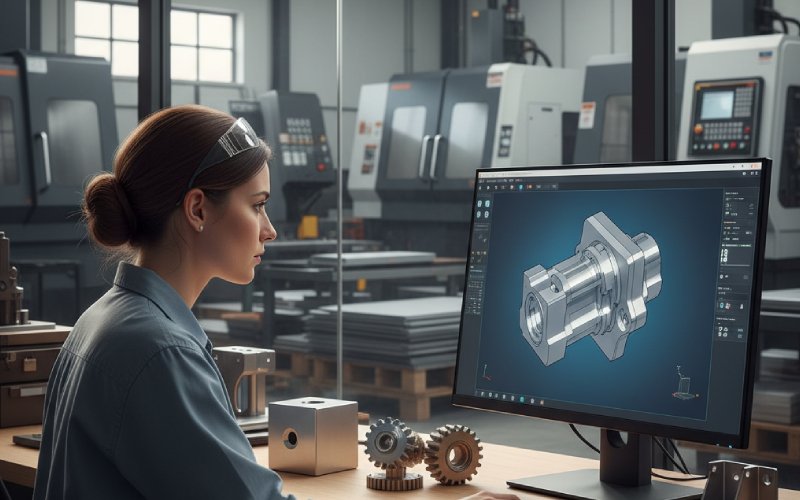
Here is one way to think through a new part, in normal project time, not in an ideal world.
First, write down three facts: the most likely annual volume in the first year, the one or two dimensions that absolutely must be controlled for function, and how many times you expect to revise the part after first customer use. That is enough to choose a starting bias. If volumes are low and the design might change, assume CNC until proven otherwise. If the part is an enclosure, bracket, or frame with moderate or high volumes and modest tolerances, start from sheet metal.
Next, stress-test that bias against geometry. Ask whether the shape can genuinely be created from flat stock without tricks that compromise stiffness or fit, and whether local precision can be recovered with inserts or secondary operations if you choose sheet metal. If the answer is “yes, but only with a mess of tiny flanges, spacers, and shims,” the design may be forcing the wrong process and needs re-work.
Then talk to a real supplier on each side. This is often skipped, yet several manufacturing guides show that early supplier input on DFM and quoting shifts costs more than any abstract rule of thumb. Share the same model with a CNC shop and a sheet-metal shop, ask for a realistic quote at your expected volume, and pay attention not just to price but to the problems they flag.
If one option comes back with a clean quote and the other with a long list of caveats, it is a signal. Not proof, but a strong hint that your geometry and requirements align more naturally with one process.
Choosing between CNC and sheet metal is not a branding exercise; it is a trade-off between geometry, volume, tolerance, and change risk. CNC is usually the rational starting point for thick, 3D, precision-critical parts in uncertain or modest volumes. Sheet metal tends to own thin, repeatable structures at scale, especially when the design is mature and the tolerance stack is forgiving. The best teams treat the process as a design variable, shift parts between methods as the product matures, and use hybrids when that is the simplest way to let each process do what it is already good at.