Let Istar help you get started on your project with our experience and know-how!
Upload your design files and production requirements and we will get back to you within 30 minutes!
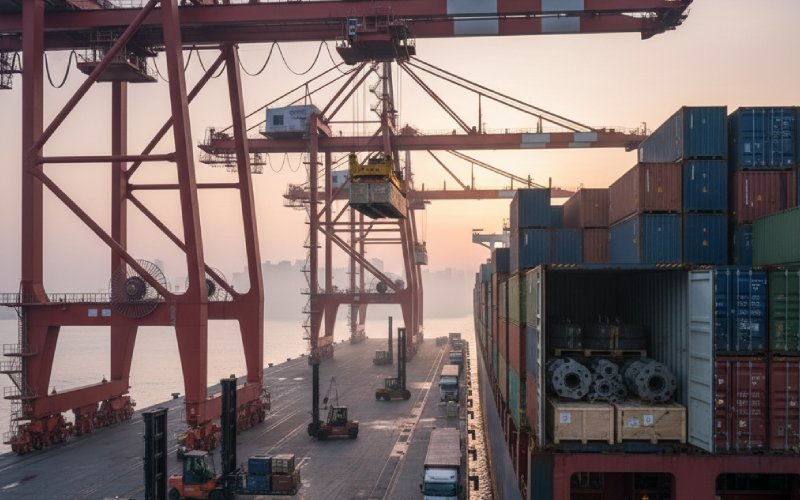
CNC machining buyers usually optimise unit price, cycle time, maybe tooling. Then the first 40-foot container of heavy machined parts lands, and the freight invoice is twice what finance expected.
You probably already know the words: Incoterms, landed cost, THC, demurrage, HS code. So this isn’t a 101. This is the stuff that still bites after you’ve read the manuals.
A box of electronics scales almost linearly with volume. A pallet of steel blocks or gantry plates does not.
For heavy machined parts, a few things skew the math:
On paper, the freight is “$X per container”. In reality, the bill is a collection of small line items constructed around those three problems.
Most buyers start reading at the ocean freight line. That’s already the middle of the story.
The awkward money is between CNC shop door and port gate.
Crating for heavy machined parts is almost its own engineering task now. Many ports and buyers ask for a documented packing plan: bracing locations, lifting points, moisture protection details, and stress paths.
Hidden angles:
For a 4-ton welded frame, the local truck move is not “just trucking”.
Common extra lines:
These are rarely shown on the machining quote. They sit in the forwarder’s small print.
Now you reach terminal handling and paperwork. This is where abbreviations start: THC, VGM, DOC, SEAL, etc. Carrier tariffs show it clearly; we just don’t always read that far down.
Look for:
These amounts are predictable, but only if you pull the tariff sheet instead of just trusting the headline rate.
The base ocean rate is now the most visible and sometimes the least interesting part.
For heavy, dense cargo, the following tend to appear:
All of these are completely normal from the carrier’s perspective. From a CNC purchaser’s perspective, they just appear as “extra +x%” on top of what looked like a locked quote.

If one part of the chain is going to generate awkward emails with finance, it’s usually the destination port.
For heavy industrial equipment and machined parts, duty rates often look modest on paper. The catch is the base they apply to.
Many jurisdictions use CIF value (cost + insurance + freight) as the base for duty and tax:
Duty = (Product cost + International freight + Insurance) × Duty rate
Then VAT / GST is applied on top of that subtotal. If you mis-estimate freight by 30–40%, your tax estimate is wrong too.
Extra wrinkles:
A container arriving with heavy machined parts may trigger:
These are not “hidden” to the port. Just hidden in your budgeting process when freight is collapsed into one line.
Heavy parts tend to sit longer:
Every extra day the container sits on the terminal (demurrage) or outside the terminal with you (detention) is billable, often at an increasing daily rate after the free days expire.
For a heavy CNC shipment, a week of delay can add enough cost to wipe out the margin on the machining itself.
The last 50 km often cost more than the previous 5,000 km.
Line items to watch:
These are typically booked locally by your team, not your CNC supplier. So they vanish completely from the RFQ discussion, then reappear as “unplanned” in project P&L.
This is where machining engineers usually underestimate their reach. Changes made to hit a machining target can quietly shift shipping up a bracket.
Some examples:
The shipping group often has no seat at the design review, so the cost change appears months later in freight quotes, not in the design room where it started.
Instead of adding “+20% for freight” and hoping it’s close, you can structure your thinking a bit more mechanically.
Think like this:
Then you can express cost in three views:
This gives the sourcing decision something more solid than “Supplier B is 8% cheaper per part”.

Here’s a compact view you can drop into your internal playbooks.
| Cost element | Usually billed by | Where it hides in quotes | Impact for heavy machined parts | Key question to ask supplier / forwarder |
|---|---|---|---|---|
| Export crating & packing | CNC supplier / packer | “Packing”, or not mentioned at all | Extra wood, blocking, rust protection, labour | Who designs and certifies the crate and how is it priced? |
| Inland haulage to port | Forwarder / trucker | Small line or baked into “FOB” | Special trailers, permits, cranes, waiting time | Is the quote for standard trucks or special equipment? |
| Origin port THC & docs | Ocean carrier / forwarder | Port fee bundle | Per-container fees, admin per shipment | Can you itemise THC, documentation, VGM, security fees? |
| Fuel & bunker surcharges | Carrier | Added on top of base ocean rate | Variable with lane and time; noticeable on dense cargo | What surcharges apply on this lane this quarter? |
| Equipment imbalance / peak season | Carrier | Surcharges section | Adds percentage or fixed USD per container | Are there equipment imbalance or seasonal surcharges expected? |
| Insurance | Insurer / forwarder | “Cargo insurance” line | Under-insuring looks cheap until there’s damage | What value and coverage clauses is this based on? |
| Destination THC & local port fees | Terminal / forwarder | Destination charges bundle | Often underestimated; can rival origin costs | Can you share the latest destination port tariff sheet? |
| Customs brokerage & gov. fees | Broker / agent | Clearance service fee | Fix + variable charges per HS code and regime | Which HS codes are you using and what are their rates? |
| Duties, tariffs, VAT / GST | Customs authority | Out of scope in supplier quote | Sensitive to CIF value changes and trade measures | What is our duty and tax exposure at today’s rates? |
| Demurrage & detention | Carrier / terminal | Not on initial quote | Escalating daily rates when things slip | How many free days, and what are day-by-day rates after that? |
| Last-mile rigging and cranage | Local logistics provider | Project budget, not freight sheet | Cranes, riggers, permits, overtime, risk premiums | What are realistic site constraints and time windows? |
| Compliance add-ons (e.g. DG, ISPM) | Various | Certification and inspection charges | Wood treatment, DG docs, inspections | Are any parts or materials triggering special compliance rules? |
Use the table as a checklist when reviewing RFQs or comparing suppliers from different regions.
Not all suppliers want to talk about shipping. Some just say “EXW” and stop there. But for heavy machined parts, the machining and freight models are connected.
You can nudge the conversation into more productive territory:
When a CNC shop understands that freight performance influences whether you reorder, they usually adapt their process.
You can skim this section the next time you approve a large overseas CNC machining order:
If any answer is “not really”, the total cost of that “cheap” CNC part is still unknown.
Start with a rough design envelope and weight, then ask your forwarder for indicative origin/destination charge tables and ocean rates for that lane. Combine those with current duty/VAT bands for the HS codes you expect. Many logistics providers now offer simple landed cost calculators that bundle product cost, freight, duties, and taxes into a single model.
Even a coarse model is better than a percentage guess added at the end.
For most industrial buyers, it’s a tie between demurrage/detention and underestimated inland / rigging costs. Heavy cargo moves slower, needs more coordination, and consumes more free days. Once the free period expires, daily charges rise quickly. At the same time, cranes, escorts, and overtime at the receiving site are often scoped lightly.
Only when the cost of line stoppage or project delay is significantly higher than a very expensive air bill. For dense steel parts, air freight is usually used for small urgent spares, engineering samples, or rework parts—not full production shipments. If air starts to look attractive regularly, that usually signals either an unreliable supply chain or design choices that are too sensitive to small timing slips.
By treating shipping constraints as design inputs:
Break large structures into lift-friendly modules that fit standard containers and local lifting gear.
Keep envelopes within common road permit thresholds where possible.
Provide integrated lifting points that align with generic rigging equipment.
Co-design with your CNC supplier and forwarder so crate and pallet standards are known during design, not after.
There’s no single answer. A supplier who ships similar heavy parts on the same lanes every week might secure better rates and cleaner processes. On the other hand, your own logistics team might manage duty optimisation, HS classification, and carrier diversification more consistently across all your categories.
A practical compromise: let the CNC supplier quote two options:
Ex-works / FOB (you own logistics).
DAP / DDP (they manage logistics).
Then compare full landed cost and operational risk for each, not just the machining price.
Brief checklist:
Ask up front for a breakdown of all local and international logistics charges, not just an ocean rate.
Get written confirmation of HS codes and duty assumptions from your broker.
Require crate drawings and packing specs with the machining quote for heavy items.
Model three scenarios: best case, expected, and slow-clearance (for demurrage/detention).
After the first shipment, do a quick post-mortem: compare predicted vs actual cost, and adjust your internal template.
Do this once for each new trade lane or product family. The second shipment will be calmer. The numbers will be less mysterious. And your CNC sourcing decisions will be based on total cost, not only on machine-hour rates.