Let Istar help you get started on your project with our experience and know-how!
Upload your design files and production requirements and we will get back to you within 30 minutes!

If you’ve ever held two “silver” aluminum parts side-by-side and wondered why one looks calmly premium while the other looks… kind of streaky and temperamental, you’ve already met the difference.
Mill finish and clear anodized aluminum start as the same metal. The split happens at the surface—where the real world (hands, rain, salt, cleaners, UV, friction, time) does its daily work. Choosing between them isn’t about which one is “better.” It’s about what kind of abuse you’re quietly signing up for.
Mill finish is aluminum in its as-produced state—straight from rolling/extrusion, with no added finishing step meant to standardize appearance or boost surface durability.
That sounds boring, but it’s also the point: you’re buying the metal, not the “skin.”
Mill finish commonly comes with visible extrusion/rolling lines and occasional light staining from how it’s processed and cooled—usually cosmetic, not structural. And because it’s the final look, those marks don’t “go away later” unless you add a finish later.
A few honest truths about mill finish:
Aluminum naturally forms a thin oxide layer that protects it from further attack. This oxide “skin” reforms if scratched and thickens slowly over time, often darkening depending on pollution and exposure.
So no—mill finish aluminum isn’t fragile. It’s just honest. The surface will evolve, and the evolution is not always aesthetically polite.
In some environments, that natural protection is plenty. But in others (coastal spray, aggressive cleaners, constant touching, abrasion), you’ll start wishing the surface had a tougher coat.
Mill finish can also develop oxidation spots during long shipments if moisture gets involved, so packaging/handling matters more than most people expect.
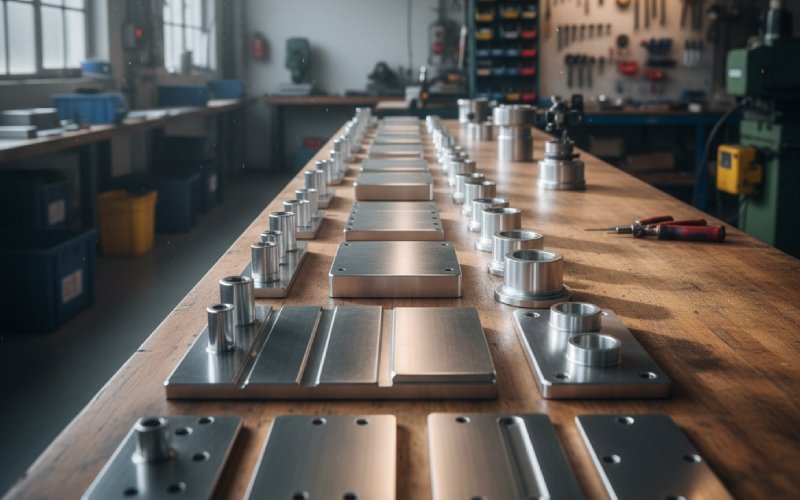
Clear anodizing is an electrochemical process that thickens the aluminum oxide layer into a harder, more durable, more controllable surface. The most common process is sulfuric acid anodizing (often called Type II), which produces a colorless/transparent anodic coating on most aluminum alloys.
This coating isn’t paint. It doesn’t “sit on top” and peel. It’s integrated with the surface—one reason architects and manufacturers like it for parts that must keep looking intentional over time.
Typical Type II thickness ranges vary by spec and need, but commonly fall around:
Thickness isn’t the whole story: sealing quality matters a lot for corrosion performance, and many finishers recommend sulfuric anodizing above certain micron ranges depending on exposure.
Mill finish often reads as brighter-but-less-uniform. Clear anodize often reads as slightly more “satiny,” more even, and more stable under fingerprints, cleaning, and sunlight. In architectural hardware contexts, clear anodized is frequently preferred for uniformity and durability against cleaners, UV, and weather oxidation.
Here’s the human translation:
| Category | Mill Finish Aluminum | Clear Anodized Aluminum |
|---|---|---|
| What it is | As-produced surface, no finishing step | Thickened oxide layer created by anodizing |
| Appearance | Semi-dull/semi-reflective; may show lines/staining | More uniform finish; often preferred visually in hardware contexts |
| Scratch/scuff visibility | Scratches/nicks show easily and remain visible | Better abrasion resistance; holds up better with use/cleaning |
| Corrosion resistance | Good baseline due to natural oxide “skin” | Improved durability/corrosion performance with proper anodize + sealing |
| UV resistance | Metal itself is stable; appearance may weather/darken over time | Often described as unaffected by sunlight/UV in finish performance contexts |
| Dimensional impact | None from finishing | Adds dimensional growth (a portion of coating thickness contributes to growth) |
| Cost & lead time | Lowest cost; fastest availability | Higher cost; extra process step and scheduling |
A better way to choose is to ask: What happens if the surface changes? Because it will.
If the part is hidden, touched rarely, and lives in a mild environment, mill finish is often the smart, economical call.
If the part is visible, customer-facing, frequently handled, cleaned, or exposed to abrasion/corrosion risks, anodizing becomes less “upgrade” and more “insurance.”
A quick way to think about it:
Mill finish is underrated when you’re honest about what matters.
Choose mill finish when:
Practical examples:
Clear anodize shines when the surface needs to behave like a product, not just a material.
Choose clear anodized when you care about:
Common real-world uses:
Clear anodize is transparent, but the underlying alloy chemistry still changes how it looks. Different alloys (and even different lots/tempers) can anodize to slightly different shades, which becomes obvious when parts are adjacent.
If you need visual consistency:
Even “clear” anodizing can create measurable dimensional growth. A common rule-of-thumb is that a portion of anodize thickness contributes to growth (e.g., ~30% cited in some guidance).
That’s usually irrelevant for trim—but it matters for tight fits, sliding assemblies, and precision mating surfaces.
Anodized aluminum is electrically insulating at the surface (it’s an oxide layer), which can be a feature or a problem. Type II anodize is often discussed in terms of dielectric behavior and reduced conductivity at the surface.
If you need a ground path or metal-to-metal electrical contact:
This is one of the most common “we didn’t think of that” surprises in enclosures and mounting systems.
If you only read one section, read this.
Ask these five questions:
Rules of thumb:
Mill finish can last a long time structurally, but it may need periodic cleaning in sheltered areas where deposits accumulate (especially in building contexts).
Clear anodized surfaces generally hold up better to routine cleaning and everyday wear, which is why they’re so common in visible architectural and product surfaces.
A simple mindset shift helps:
Mill finish aluminum is the right answer when cost is king, appearance is secondary, and the environment is kind.
Clear anodized aluminum is the right answer when the surface is the product—when you want uniformity, better wear behavior, and a finish that keeps looking intentional under real-world handling and weather.