Let Istar help you get started on your project with our experience and know-how!
Upload your design files and production requirements and we will get back to you within 30 minutes!
If you work with steel parts that live in ugly conditions – grit, moisture, sliding contact, pressure – you eventually run into the same headache: how do I keep this thing from wearing out or rusting without blowing up my tolerances or my budget?
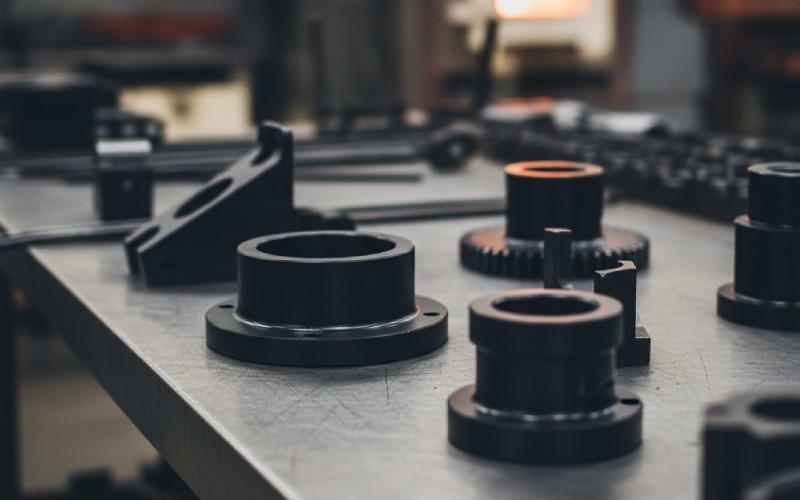
That’s exactly the problem a Quench Polish Quench (QPQ) finish service is built to solve. QPQ is a specific form of salt bath ferritic nitrocarburizing followed by polishing and re-oxidation. It builds an extremely hard, corrosion-resistant surface with almost no growth, and leaves a deep black, low-friction finish.
In this guide we’ll go beyond the usual marketing bullets. We’ll unpack what actually happens in the bath, where QPQ shines (and where it doesn’t), and what to look for in a service provider so your parts don’t become someone’s “learning experience.”
At its core, QPQ is not a paint, not a plated layer, and not a simple black oxide. It’s a thermochemical treatment that changes the chemistry of the steel surface itself by diffusing nitrogen (and a bit of carbon) into it while the steel remains in the ferritic phase – typically around 525–625 °C.
The process starts as salt bath ferritic nitrocarburizing (also marketed under names like Tufftride®, Tenifer®, Melonite®, CLIN®, etc.). In a molten bath of alkali cyanate/carbonate, the salt reacts with the steel’s surface to form a two-part case: a very hard compound (white) layer at the top and a tougher diffusion zone beneath. Because this happens below the transformation temperature, parts see minimal distortion compared to high-temperature case hardening or carburizing.
What makes QPQ special is what happens after that initial nitrocarburizing: a controlled cycle of cooling, polishing, and re-oxidizing that builds a dense iron-oxide film (typically 2–4 μm) on top of the nitride layer. This thin oxide is a big part of the finish’s impressive corrosion resistance and trademark satin-black appearance.
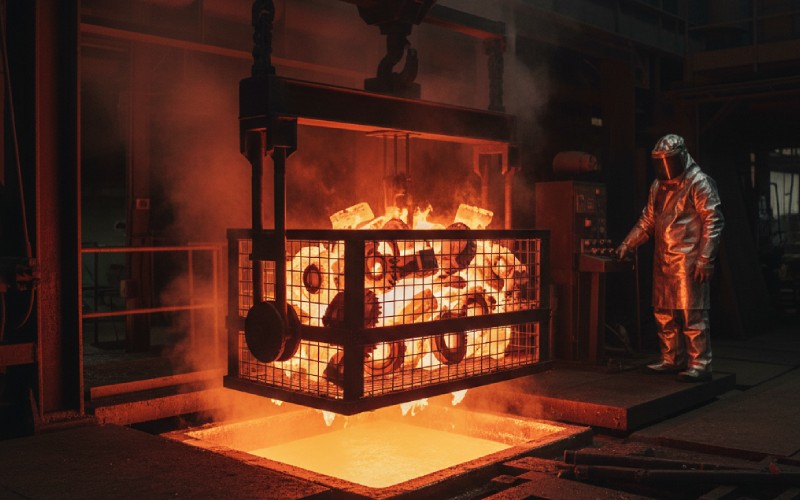
When you send parts to a QPQ finish service, you’re not just paying for “time in a tank.” You’re paying for process control, cleanliness, and repeatability. Here’s how a good service typically runs a job, minus the marketing gloss.
First comes surface preparation. Parts are degreased, often ultrasonically cleaned, and sometimes pre-blasted or pre-polished. Any residual oil, scale, or contamination can interfere with nitrogen uptake or cause blotchy oxide patches. For complex parts, smart fixturing is half the battle: hanging arrangements are chosen so salts drain properly and blind holes don’t trap gas.
Then the nitrocarburizing stage begins. Parts are preheated, then immersed in the molten cyanate-based bath. At roughly 540–580 °C (for common CLIN/Melonite systems), nitrogen and carbon diffuse into the surface. Treatment times from 30–210 minutes are typical, tuned to hit a target compound layer thickness and case depth for your steel and application.
After the first quench / cooling, parts go through mechanical polishing. This might be vibratory finishing, centerless grinding, lapping, or a combination. The aim isn’t to strip the compound layer; it’s to knock down roughness, remove loose porosity, and hit a specified Ra – often in the ~0.4 μm (16 μin) ballpark or better for seal surfaces.
The second “quench” is post-oxidation. Polished parts are re-immersed in a lower-temperature oxidizing bath. A dense iron-oxide film grows over the nitride, restoring any oxide removed during polishing and sealing the surface. Finally, parts are rinsed, sometimes subjected to a water-based passivation step, and almost always oil-dipped or sealed to maximize corrosion performance and give that smooth, deep-black sheen.
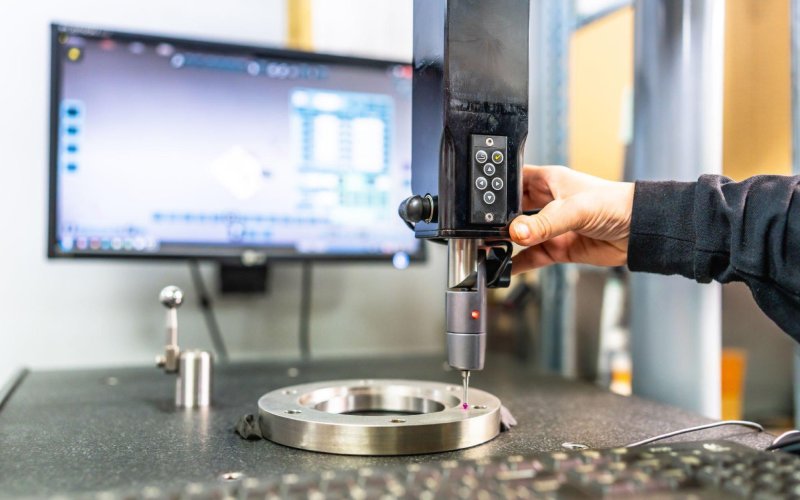
In a high-end QPQ service, the last (and often invisible) stage is quality control: microhardness traverses to confirm case depth and hardness, metallographic checks of the compound layer, and periodic salt spray or immersion tests against standards like ASTM B117 / DIN 50021 to track corrosion performance over time.
To decide whether to use a QPQ finish service, you need context: how does it compare with other common options like black oxide, hard chrome, or conventional nitriding?
At a microstructural level, QPQ is doing more than just coloring the surface. The combined nitride + oxide stack offers a tough outer skin backed by a compressive, hardened diffusion zone. This combination explains why QPQ-treated steels often show significantly higher wear life and salt-spray performance than untreated steels, simple black oxide, and even some plated layers of similar thickness.
Here’s a simplified comparison (values are typical ranges, not guarantees – actual results depend heavily on alloy and exact process):
| Finish / Process | Surface hardness (approx.) | Corrosion resistance* | Dimensional change | Typical appearance | Where it shines |
|---|---|---|---|---|---|
| QPQ (salt bath FNC + oxide) | ~800–1500 HV (≈60–70 HRC) | High – salt-spray performance often better than hard chrome and some stainless grades in controlled tests | Very low (tens of μm); often “zero-growth” for practical tolerances ([ruixing-mfg.com][10]) | Uniform satin to matte black | Precision ferrous parts needing wear + corrosion resistance |
| Hard chrome plating | ~800–1000 HV | Medium – excellent wear, but crack networks limit corrosion performance | Moderate; thickness commonly 10–25 μm or more | Bright silver, can chip or flake if overstressed | Legacy wear surface, shafts, hydraulic rods where regulations permit |
| Black oxide | Near base steel hardness (very thin conversion) | Low–medium – usually needs oil or wax to resist rust | Negligible; film ~1 μm | Matte black, “grippy” feel | Low-cost cosmetic or low-risk indoor parts |
| Gas / plasma nitriding (no oxide) | Up to ~1000–1200 HV | Medium – better than untreated, but usually less than QPQ unless combined with a topcoat | Very low; similar to QPQ | Grey to dull metallic | High-hardness cases where black finish isn’t needed |
| Stainless steel (no treatment) | Depends on grade; often 150–300 HV | Good general corrosion resistance but can pit in chlorides; wear resistance limited | Base material | Silver metallic | Chemical/food environments, moderate wear |
*Corrosion resistance comparison is based on neutral or acetic salt-spray and immersion tests referenced in nitrocarburizing literature and manufacturer data.
The big takeaway: QPQ is unusually balanced. You get hard-chrome-like wear resistance, corrosion resistance that can rival or exceed stainless steel in some environments, near-zero distortion, and a cosmetic finish in a single integrated sequence.
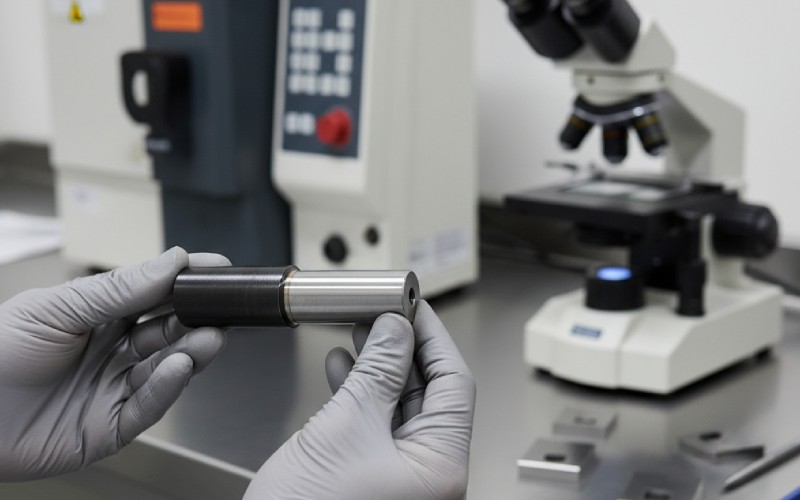
Not all “QPQ” is created equal. The underlying chemistry is well understood, but the details of bath maintenance, cleaning, fixturing, and QC are where a shop either becomes a trusted partner or a source of expensive surprises.
A solid provider should be transparent about the process window they’re running: bath chemistry control, temperature range, typical treatment times for your material, and how often they analyze and refresh salts. Since cyanate baths convert partially to carbonate during runs, regular reactivation is essential to keep nitrogen activity high and avoid soft or inconsistent cases.
Capability limits matter too: maximum part size, weight, and whether they can handle long slender shafts without excessive distortion or handling damage. Some facilities can process parts over a meter in diameter and several meters long in one shot, while others are best for smaller precision components.
Finally, look carefully at environmental and safety practices. Salt baths, especially older formulations, are not the most environmentally friendly technology, and they require strict handling, ventilation, and waste-treatment controls. Good shops will be upfront about their safety procedures, permits, and how they manage spent salts and rinse waters.
From a design or manufacturing engineer’s point of view, QPQ works best when you design for the process from day one rather than “finish-shopping” at the end of a project.
Try to keep consistent wall thickness and avoid sharp internal corners where stress and case depth gradients concentrate. Beneath the compound layer, the nitrogen-rich diffusion zone introduces compressive residual stress, which is great for fatigue, but abrupt section changes can still become fatigue hot-spots.
Think through masking and tolerance chains early. Because the process adds so little thickness, QPQ can often be the final step after machining and heat treatment, but threaded or precision-fit surfaces might need specific instructions: either mask them, finish-machine after treatment, or account for the small, but non-zero, case growth in your tolerance stack-up.
It’s also worth planning inspection and testing upfront with your service provider. Agree on which characteristics are critical – case depth, hardness, Ra, appearance, corrosion hours – and build those into your print notes or purchase specifications. That way, when batches start flowing, you’re not arguing about what “good” looks like; you’re both tracing back to the same agreed metrics and test methods.
Finally, be realistic about the environment. QPQ can produce corrosion resistance measured in hundreds of hours of salt-spray performance, sometimes several times better than hard chrome or even some stainless steels – but nothing is indestructible. Constant abrasive wear in seawater or strong chemicals will eventually chew through any surface system, and sometimes additional coatings, paints, or sealing strategies on top of QPQ make sense.
A quench polish quench finish service is more than just a black cosmetic treatment – it’s a carefully tuned surface engineering system that blends diffusion hardening, controlled polishing, and chemical oxidation to create a small but mighty skin on your parts. When it’s matched correctly to your steel, geometry, and environment, QPQ can stretch component life dramatically while maintaining tight tolerances and giving a professional appearance.
If you’re considering QPQ, the most “human” and effective way to approach it is simple:
Do that, and QPQ stops being just another line item on a quote – it becomes a deliberate lever you can pull to make your products last longer, look better, and cause fewer late-night failure calls.